Hey there! As a supplier of plain aluminum foil rolls, I often get asked if these seemingly ordinary rolls can be used to create a reflective surface. Well, let's dive right into it and find out!
First off, let's understand what makes a good reflective surface. A reflective surface needs to have the ability to bounce back a significant amount of light that hits it. Metals are generally good candidates for this because of their free electrons. When light photons strike the surface of a metal, these free electrons interact with the photons and re - emit them, causing reflection.
Aluminum is a metal that has excellent reflective properties. It reflects a large portion of visible light, infrared light, and even ultraviolet light. This is why it's used in so many applications where reflection is important, like in mirrors and satellite dishes.
So, can a plain aluminum foil roll be used to make a reflective surface? The short answer is yes! The shiny side of aluminum foil, which is the side that has a smoother finish, can act as a decent reflective surface. The smoothness helps in minimizing the scattering of light, allowing it to reflect in a more organized way.
Let's talk about the science behind it a bit more. The reflectivity of a material is measured by its reflectance factor, which is the ratio of the reflected light to the incident light. Aluminum has a high reflectance factor, typically around 80 - 90% in the visible light spectrum. This means that a large proportion of the light hitting the aluminum foil will be reflected back.
One of the great things about using plain aluminum foil for making a reflective surface is its versatility. You can easily cut and shape the foil to fit your needs. Whether you're making a small DIY reflector for a photography project or a larger one for a solar cooker, aluminum foil can be manipulated with basic tools.
Now, let's consider some practical applications. In photography, you can use a piece of aluminum foil to create a makeshift reflector. By placing it on one side of your subject, you can bounce light onto the shadow areas, filling them in and creating a more even lighting. It's a cheap and easy solution, especially if you're on a budget or don't have access to professional reflectors.
For solar cookers, aluminum foil's reflective properties can be put to great use. The foil can be lined inside a parabolic or box - shaped cooker to direct sunlight towards the cooking area. This helps in concentrating the solar energy and increasing the cooking efficiency.
Another interesting application is in insulation. Aluminum foil's ability to reflect infrared radiation makes it useful in radiant barriers. When installed in attics or walls, it can reflect the sun's heat away from the building, reducing the cooling load in the summer.
However, there are a few limitations to using plain aluminum foil as a reflective surface. One of the main issues is durability. The foil is quite thin and can easily tear or get damaged. If it's exposed to harsh environmental conditions, like strong winds, rain, or extreme temperatures, its reflective properties may deteriorate over time.
The surface of the foil can also get dirty or oxidized, which can reduce its reflectivity. Oxidation occurs when aluminum reacts with oxygen in the air, forming a layer of aluminum oxide on the surface. This layer is not as reflective as the pure aluminum surface, so it's important to keep the foil clean and protected if you want to maintain its reflective performance.
In terms of the quality of the reflective surface, it may not be as good as a professional - grade reflector. The foil's surface may have small imperfections, such as tiny wrinkles or rough spots, which can cause some scattering of light. This scattering can make the reflected light less focused and less intense.
As a supplier of plain aluminum foil rolls, I offer different types of foil that can be used for creating reflective surfaces. For example, our 8011 Food Aluminum Foil is made from high - quality aluminum alloy. It has a smooth surface and good reflectivity, and it's also food - safe, so it can be used in applications where hygiene is important, like in some types of solar food dryers.
Our Standard Aluminum Foil Roll is a more general - purpose option. It's suitable for a wide range of DIY projects where you need a reflective surface. It's available in different widths and lengths, so you can choose the one that best fits your needs.
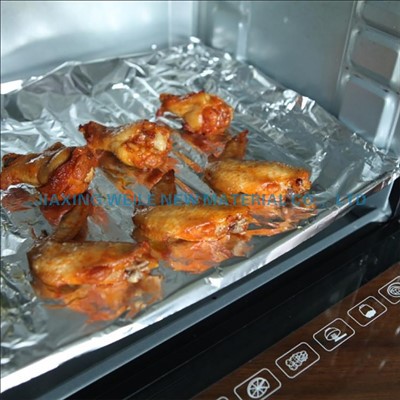
If you're into baking and also want to use the foil's reflective properties, our Baking Pastry Aluminum Foil Paper Roll is a great choice. It can be used not only for baking but also for creating small reflectors in the kitchen, like for reflecting heat onto a particular part of a dish.


In conclusion, a plain aluminum foil roll can definitely be used to make a reflective surface. It has good reflective properties, is versatile, and is relatively inexpensive. However, it does have some limitations in terms of durability and the quality of the reflective surface. If you're looking for a quick and easy solution for a small - scale project, aluminum foil is a great option. And if you need high - quality aluminum foil for creating reflective surfaces, feel free to get in touch with us. We're always ready to discuss your requirements and help you find the right product for your needs. Contact us to start a purchase negotiation and explore how our aluminum foil can meet your reflective surface needs.
References
- Physics textbooks on optics and materials science
- Industry reports on the properties and applications of aluminum foil